Electric Potential
Electric Potential
Electric potential, electromotive force (emf), electrical pressure and voltage are synonymous terms. In the SI system of units, they are expressed or measured in volts. When the voltage at a power outlet is 120 volts, the electric potential, electric voltage, and the electric pressure at the outlet is of the same magnitude:
$$\textrm{1 Volt}=\frac{\textrm{1 Joule}}{\textrm{1 Coulomb}}$$
$$10^{3 } \textrm{ V}=\textrm{1 kV}$$
$$10^{-3 } \textrm{ V}=\textrm{1 mV}$$
Voltage is the intensity of an electrical energy source just as temperature is the intensity of a heat source. Voltage and temperature are destructive only when they are associated with high-energy sources.
For example, the temperature of a lighted match is about 95 C. When you place your finger on the match, it hurts, but it does not kill you. In contrast, somebody immersed in a home’s hot water tank 60 C would be seriously injured.
Similarly, the threshold of static sensation, which is about 4000 V, does not injure because it is not accompanied by sufficient electrical charges. In contrast, the 120 V across a home’s receptacle may be fatal to anyone who comes in contact with it.
Voltage has a meaning when and only when it is measured with respect to the reference point. The reference terminal is often the neutral or the ground wire. These two wires as per electrical code requirements are connected together in the premises’ electrical entrance. Stating that the voltage at a particular point is 120 V implies what this voltage is with respect to ground.
Designation
Refer to Figure 1-1. The voltage at terminal B is at 10 V with respect to that of terminal A. Mathematically,
$$V_{BA}=\textrm{10 V}$$
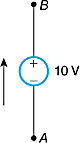
Figure 1-1 Voltage designation.
The voltage, however, at A is at −10 V with respect to point B.
$$V_{AB}=\textrm{- 10 V}$$
Instead of the polarities + and −, you may use an arrow to indicate relative polarities, as shown in Figure 1-1.
All main and secondary power distribution networks are characterized by a voltage source. The voltage source may be of constant amplitude (a dc voltage source) or of alternating waveform (an ac voltage source). The various waveforms—whether they represent voltage, current, or power—can be described in terms of their instantaneous, effective, or average values.
Instantaneous Value
The instantaneous value of a waveform is given by a general equation that describes the waveform as a function of time. For example, the instantaneous value of the voltage waveform that is available in a residential single-phase power outlet is
$$\begin{matrix} v=V_{m}\times sin\omega t & (1.1) \end{matrix}$$
where $v$ is the instantaneous value of the voltage, $V_{m}$ is its maximum value, and $\omega$ is its angular frequency of oscillation.
The angular frequency of oscillation is given by
$$\begin{matrix} \omega =2\pi f=\frac{2\pi }{T}\textrm{rad/s} & (1.2) \end{matrix}$$
where f and T are, respectively, the frequency and the period of oscillation of the voltage waveform. A sinusoidal voltage waveform is shown in Figure 1-2.
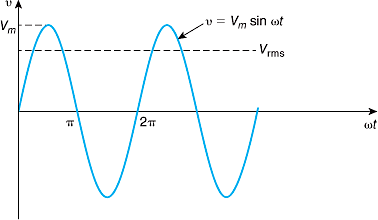
Figure 1-2 A sinusoidal voltage waveform.
The standard frequency of oscillation of the current and voltage waveforms of single-phase and three-phase power sources in North America is usually 60 Hz. In some other parts of the world it is 50 Hz.
The instantaneous values of the various functions are in general represented by the lower-case letters with or without the time-function notation. Thus, $\textrm{\textit{v (or v(t))}}$ and $\textrm{\textit{i (or i(t))}}$ represent the instantaneous values of voltage and current.
Effective Value
The effective or root mean square (rms) of a voltage waveform is given by
$$\begin{matrix} V=\frac{1}{T}\int_{0}^{T}v^{2}dt & (1.3) \end{matrix}$$
where $v$ is the instantaneous value of the voltage waveform.
Root-mean-square values have been introduced because the heating effect of an ideal sinusoidal voltage waveform in a resistor is equal to that produced by a dc source that has the same voltage as the rms value of the given ac waveform.
In addition, the usage of rms values simplifies the final form of voltage, current, and power formulas. In designating rms values, the capital letter of the parameter is usually used without any subscript. Thus, V and I correspond, respectively, to the rms values of the voltage and current.
The voltage rating of all ac apparatuses is given by the equivalent rms values. Thus, when a voltage is indicated as being 208 V or 480 V, it is understood that the magnitude is an rms value. The single-phase voltages delivered to a typical North American residence are 120 V (line-to-neutral) and 240 V (line-to-line).
The graphical interpretation of Equation (1.3) is
$$\begin{matrix} V_{rms}^{2}=\frac{\textrm{accumulation of areas under the voltage squared-time diagram over a complete cycle}}{\textrm{duration of one cycle}} & (1.4) \end{matrix}$$
The graphical interpretation of Equation (1.3), or of any other equation, helps you develop a better understanding. Understanding a concept is often as important as solving the equation itself, especially when there is no time to review the equations or when dealing with plant personnel who do not know much about integration.
Average Value
The average value (V) of a voltage waveform is defined as follows:
$$\begin{matrix} V_{av}=\frac{1}{T}\int_{0}^{T}vdt & (1.5a) \end{matrix}$$
The graphical interpretation of Equation (1.5a) is
$$\begin{matrix} V_{av}=\frac{\textrm{accumulation of areas under the v-t diagram over a complete cycle}}{\textrm{duration of one cycle}} & (1.5b) \end{matrix}$$
The average value of a symmetrical sinusoidal waveform is, as seen by inspection, equal to zero. The average value is also referred to as a dc value.
Example 1-1
Determine the rms value of the sinusoidal voltage waveform shown in Figure 1-2.
Solution
The instantaneous value of the voltage is
$$v=V_{m}\times sin\omega t $$
Substituting into Equation (1.3), we get
$$V=\frac{1}{2\pi }\int_{0}^{2\pi }\left (V_{m}\times sin\omega t \right )^{2}d\omega t$$
$$=\frac{V_{m}^{2}}{2\pi }\int_{0}^{2\lambda }\left ( \frac{1-cos2\omega t}{2} \right )d\omega t$$
$$= \frac{V_m^2}{4\pi} \left[ \left. \omega t \right|_{0}^{2\pi} - \frac{1}{2} \left. \sin(2\omega t) \right|_{0}^{2\pi} \right]$$
$$= \frac{V_m^2}{2}$$
from which
$$V_{rms}=\frac{V_{m}}{\sqrt{2}}$$
The rms value of the voltage waveform is shown in Figure 1-2.