Electric Field Parameters
Electric Field Intensity
The electric field intensity is measured in volts/meter and is related to the electric potential by the following equation:
$$\begin{equation}v = \int E \, d\ell\tag{1.16}\end{equation}$$
The minimum electric field intensity for successful radio and TV operation is about:
- Radio, AM: 0.5 m V/m
- Radio, FM: 0.5 m V/m
- Digital TV: 15 m V/m, frequency dependent
- Analog TV: 60 m V/m, frequency dependent
In the vicinity of radio or television stations, for example, the electric field intensity is relatively large. In such places, an incandescent lamp attached to a wire may—depending on the lamp’s location and the length of the wire loop—produce a glow.
where $d\ell$ is the differential of length. The electric field intensity at 10 cm in front of the computer’s screen or on the ground level below high-voltage transmission lines is about 30 V/m.
Electric field intensity is also present between two points on Earth (ground) through which a leakage current flows. The corresponding voltage is referred to as a “stray voltage.” Such voltages can cause injuries and malfunction of sensitive equipment.
The electric field intensity being a force or vector is reversed in direction when the associated voltage changes from positive to negative. This reversing force, depending on its magnitude, duration, and frequency, may be hazardous to humans. At 60 Hertz, it was incorrectly claimed that the threshold of its maximum safety level was 30 V/m. Presently, the actual safety limit is unknown. The electric field intensity, as per Maxwell’s equation, is related to the magnetic field intensity (H) as follows:
$$\begin{equation}\frac{E}{H} = 377\tag{1.17}\end{equation}$$
This equation is used to measure E.
Electric Field Flux Density
Electric flux is defined as a quantitative evaluation of electric field lines. It is represented by the number of electric field lines passing through a surface.
Electric flux density (D) is equal to the electric flux divided by the area (A) perpendicular to it. That is,
$$\begin{equation}D = \frac{\Psi}{A}\tag{1.18}\end{equation}$$
The unit of electric flux density is $\text{coulomb}/\text{m}^2$.
The electric flux density of any given material is related to the electric field intensity and the permittivity of the material by
$$\begin{equation}\varepsilon = \frac{dD}{dE}\tag{1.19}\end{equation}$$
where $\varepsilon$ is the permittivity of the material. Thus, when the flux density–field intensity curve of a material is given, its slope at the operating flux density is equal to the relative permittivity of the material (Figure 1-6).
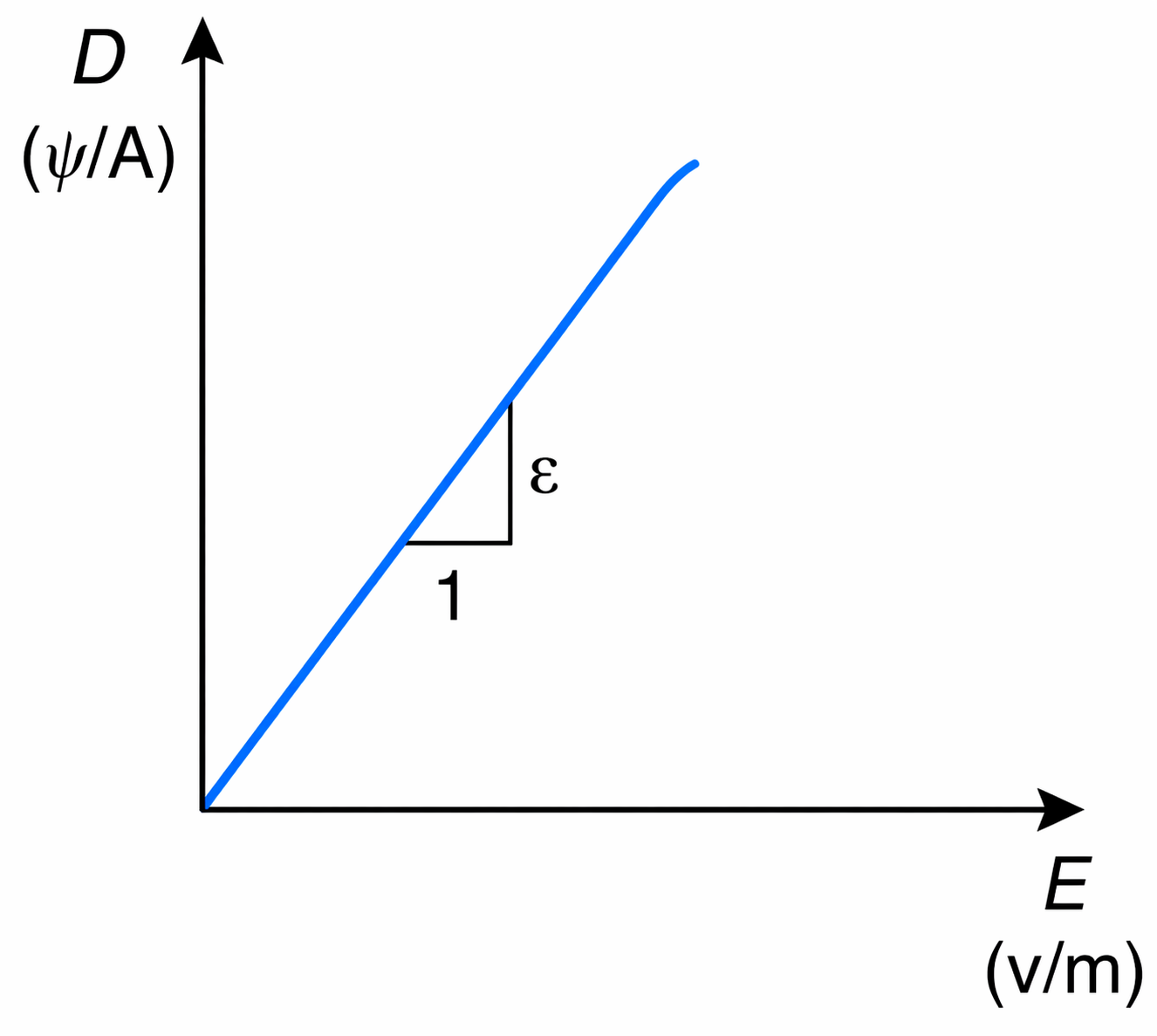
Figure 1-6 Electric flux density versus flux intensity characteristic.