RMS Calculator
RMS
Input
Output
RMS (Root Mean Square) voltage provides a single number that captures the “effective” magnitude of an AC waveform. For common sinusoidal signals, it can be calculated directly from other familiar quantities—peak voltage, peak-to-peak voltage, or the rectified average voltage—using standard conversion formulas. Because RMS corresponds to the DC voltage that would deliver the same average power to a resistor, it is the most meaningful way to specify and compare AC voltages.
Overview
When the waveform is a pure sinusoid, simple relationships connect RMS voltage to other measures of amplitude. These relationships allow you to:
Determine RMS voltage when you know the peak (Vp), peak-to-peak (Vpp), or rectified average (Vavg) voltage.
Apply compact conversion factors derived from the sinusoid’s mathematics.
Rely on these formulas primarily for undistorted sine waves; other waveforms require either the general RMS definition or direct measurement.
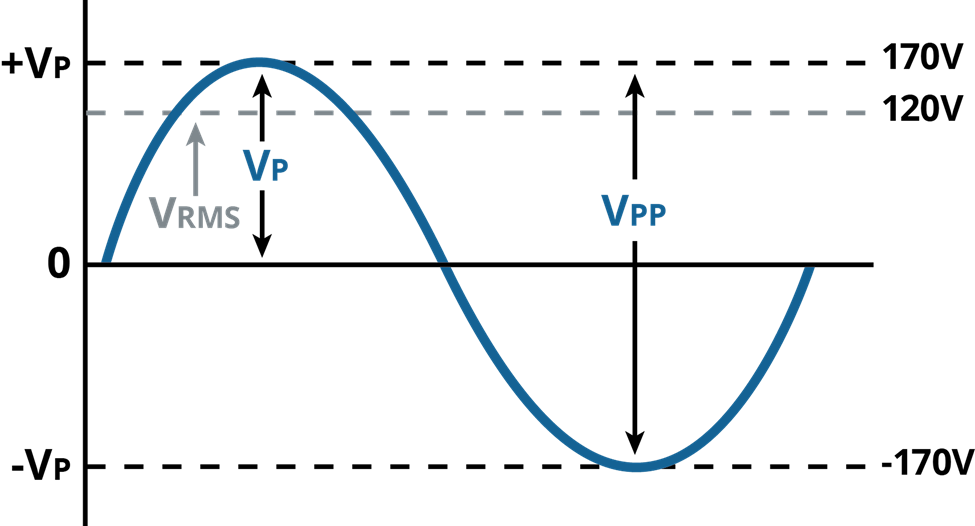
Conversion Equations
RMS from Peak Voltage
$$V_{\mathrm{rms}} = \frac{V_p}{\sqrt{2}}$$
$$V_{\mathrm{rms}} \approx 0.707 \, V_p$$
Derivation (sinusoid):
For $v(t) = V_p \sin(\omega t)$, the RMS value is
$$V_{\mathrm{rms}} = \sqrt{\frac{1}{T} \int_{0}^{T} v^2(t)\, dt}= \sqrt{\frac{1}{T} \int_{0}^{T} V_p^2 \sin^2(\omega t)\, dt}= \frac{V_p}{\sqrt{2}}$$
Example:
Given Vp = 10 V,
$$V_{\mathrm{rms}} = \frac{10}{\sqrt{2}} = 7.071 \,\text{V}$$
RMS from Peak-to-Peak Voltage
$$V_{\mathrm{rms}} = \frac{V_{pp}}{2\sqrt{2}}$$
Numerical form: $V_{\mathrm{rms}} \approx 0.353 \, V_{pp}$
Connection to peak:
A sinusoid’s peak-to-peak value is Vpp = 2Vp. Substituting Vp = Vpp/2 into $V_{\mathrm{rms}} = \frac{V_p}{\sqrt{2}}$ yields $V_{\mathrm{rms}} = \frac{V_{pp}}{2\sqrt{2}}$.
Example:
Given Vpp = 28 V,
$$V_{\mathrm{rms}} = \frac{28}{2\sqrt{2}} = 9.899 \,\text{V}$$
RMS from Average Voltage
$$V_{\mathrm{rms}} = \frac{\pi}{2\sqrt{2}} \, V_{\mathrm{avg}}$$
Numerical form: $V_{\mathrm{rms}} \approx 1.11 \, V_{\mathrm{avg}}$
Clarification of Vavg:
For a sine wave, the full-wave–rectified average is Vavg = (2/π)Vp (the mean of |sin| over one period). Combining with $V_{\mathrm{rms}} = \frac{V_p}{\sqrt{2}}$ gives $\frac{V_{\mathrm{rms}}}{V_{\mathrm{avg}}} = \frac{\pi}{2\sqrt{2}} \approx 1.1107$.
Example:
Given Vavg = 9.0 V (full-wave–rectified average), Vrms = 1.1107 × 9.0 ≈ 10.0 V.
Parameter Definitions
Peak Voltage (Vp): The maximum instantaneous magnitude of the waveform measured from zero to its positive crest.
Peak-to-Peak Voltage (Vpp): The total excursion from the negative crest to the positive crest; for a sine wave, Vpp = 2Vp.
RMS Voltage (Vrms): The square root of the mean of the squared waveform over one period. It is the DC-equivalent in terms of heating effect on a resistor.
Average Voltage (Vavg): Unless otherwise qualified, the algebraic average of a symmetrical AC waveform over a full cycle is zero. In instrumentation and conversions for sine waves, “Vavg” typically refers to the average of the full-wave–rectified waveform, equal to (2/π)Vp.
What is RMS Voltage
RMS stands for Root Mean Square and is defined for any periodic v(t) over one period T by:
$$V_{\mathrm{rms}} = \sqrt{\frac{1}{T} \int_{0}^{T} v^2(t)\, dt}$$
This definition produces the DC-equivalent value with respect to power in a resistive load. If a resistor R is driven by an AC voltage v(t), the average power is
$$P_{\mathrm{avg}} = \frac{1}{T} \int_{0}^{T} \frac{v^2(t)}{R}\, dt = \frac{V_{\mathrm{rms}}^2}{R}$$
Thus, a DC source of magnitude Vrms delivers the same average power to R as the AC waveform.
Key Insight
Because the positive and negative halves of a symmetric AC waveform cancel, the algebraic average over a full period is zero and does not reflect usable magnitude. Squaring the waveform removes sign, averaging stabilizes the result, and the final square root returns voltage units. For power calculations in resistive circuits, this RMS value directly links to $P_{\mathrm{avg}} = \frac{V_{\mathrm{rms}}^2}{R}$, which is why RMS is the standard amplitude measure for AC systems.
Assumptions and Limitations
The conversion factors are exact only for pure sinusoids. They rely on the identity that the mean of sin² over a full cycle is 1/2 and that the rectified sine’s mean is 2/π.
For distorted or non-sinusoidal waveforms (triangular, square, PWM, or harmonically rich signals), Vrms must be computed from the general definition $V_{\mathrm{rms}} = \sqrt{\frac{1}{T} \int v^2(t)\, dt}$ or measured with a true-RMS instrument. Applying the sinusoidal conversion factors to such signals will produce errors that grow with distortion (THD) and waveform shape.
Many “average-responding, RMS-scaled” meters assume a sine wave when converting rectified average to RMS; they can misreport RMS for non-sinusoids. A true-RMS meter with adequate bandwidth is required for accurate measurements on arbitrary waveforms.